Tokyo or Ueno station area
Useful when intercity departure or the airport route is the dominant constraint.
For an eight-day first trip, the central question is not how many famous places fit. It is how many hotel moves remain worthwhile after luggage, station navigation, and check-in time.
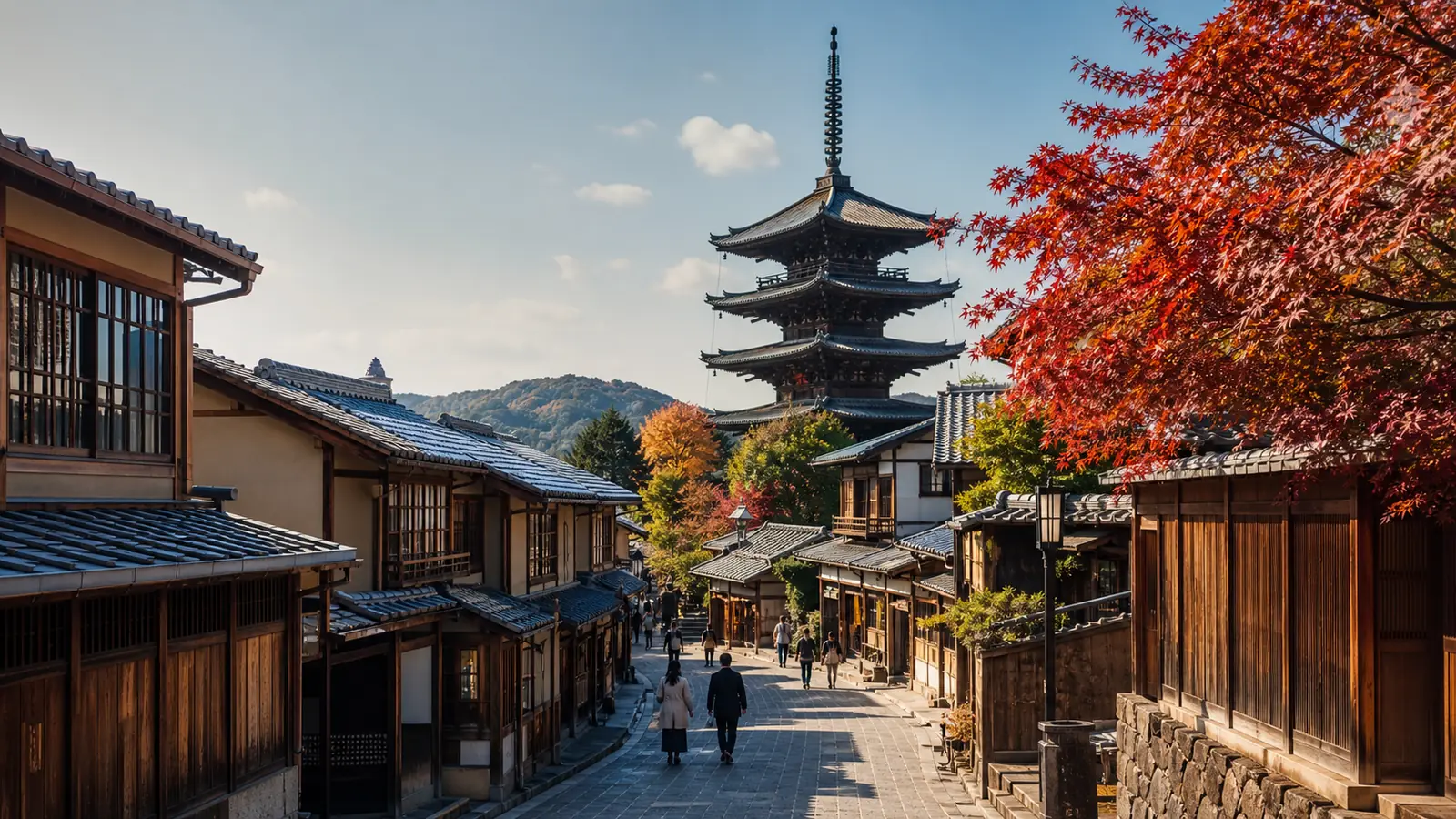
A Tokyo-and-Kyoto route is a useful first draft for many eight-day trips because it creates two geographic bases and one major transfer day. Osaka can be a day or evening visit from Kyoto if another hotel move adds more friction than value. This is a route model, not a universal itinerary.
| Pattern | What it protects | Main compromise |
|---|---|---|
| One Tokyo base | Least luggage and check-in work | Kyoto becomes impractical as a casual day trip |
| Tokyo + Kyoto | Two regions with one major move | One half-day goes to transfer and settling in |
| Tokyo + Kyoto + Osaka | More evening time in Osaka | Another checkout, luggage move, and orientation cycle |
Tokyo for days 1–4. Kyoto for days 5–8, with Osaka an optional visit on day 7. Keep the transfer day light.
The schematic shows the guide’s route model, not a navigational map or a live service.
JNTO explains that luggage forwarding and storage can reduce the need to carry bags through stations. On certain Shinkansen services, baggage with total dimensions over 160 cm requires a seat reservation with an oversized-baggage area. Check the exact train and bag before travel.
Send a large case ahead, use storage for a short stop, or reserve the correct baggage space. Do not build a tight transfer around an unverified oversized bag.
Useful when intercity departure or the airport route is the dominant constraint.
Useful for west-side interests. Large-station navigation needs extra margin.
Useful for rail arrival and luggage. Downtown may better suit evening walking.
| Arrival pattern | Planning advantage | Question to answer |
|---|---|---|
| Haneda arrival | Often a shorter city transfer | Does the route and operating time suit the chosen hotel area? |
| Narita arrival | More international flight options may be available | Which rail or bus reaches the actual hotel with the fewest changes? |
| Open-jaw arrival/departure | Can avoid backtracking after Kyoto | Does the higher airfare save enough rail time and one hotel night? |
Compare the complete airport-to-hotel route, not only the airport name. A late arrival, large bag, child, or missed last connection can change the sensible choice.
Tokyo to Kyoto is a rail-first comparison because the Tokaido Shinkansen links the city centers. A domestic flight may still belong in a wider route, but compare hotel-to-airport time, check-in, baggage, arrival transfer, and schedule risk. If the journey consumes most of a day in an eight-day trip, removing the extra region can create more value than optimizing the ticket.
| Option | Include in the comparison | Typical planning failure |
|---|---|---|
| Shinkansen | Station access, reserved seat, luggage handling, destination hotel | Assuming oversized baggage needs no reservation |
| Domestic flight | Both airport transfers, check-in margin, bag fees, disruption exposure | Comparing only airborne time |
| Drop the extra base | Activities gained, checkout removed, unused ticket risk avoided | Keeping a city only because it appeared in the first draft |
For one traveler over seven nights, excluding international flights: accommodation JPY 120,000; intercity rail JPY 30,000; local transport JPY 10,000; food JPY 40,000; admissions JPY 15,000; luggage services JPY 5,000. Subtotal JPY 220,000; 10% buffer JPY 22,000; working total JPY 242,000. Replace every figure with live quotes.
Public holidays, school breaks, major events, seasonal foliage, and operator reservation policies can change the amount of buffer needed. Before committing to non-refundable hotels, check the exact travel date on the rail operator and official tourism calendars, then protect the transfer day from timed attractions.
| Source | What it supports | Date checked |
|---|---|---|
| JR Central: luggage information | Oversized-baggage dimensions and reservation requirement on covered Shinkansen services | August 9, 2026 |
| JNTO: luggage storage and forwarding | Airport, hotel, counter, and forwarding options | August 9, 2026 |
| JNTO: Shinkansen | Network overview and reservation context | August 9, 2026 |
| JNTO: Kyoto access | Kyoto gateway and regional transport context | August 9, 2026 |
Confirm the current train, fare, reservation, airport access, and operator rules for the exact journey.
The two-base itinerary creates a rail and hotel decision. Enter your actual quotes, compare alternatives, then build a packing list around the luggage you will move.